WPSU

Thursday, September 30, 2010

What I'm Reading


I mentioned in an earlier post that, when I travel, I like to read books that relate to my travel destination.  

With that in mind, here are a few more books from our shipboard bookshelf.  And if you have suggestions for other good reads, I’d love to hear them!


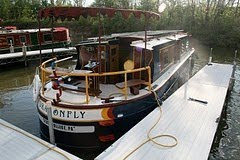
A towboat named for James Fenimore Cooper's hero
The Leatherstocking Tales, by James Fenimore Cooper (published between 1827 and 1841)

A collection of five novels spanning colonial American history from the French and Indian War to the Louis and Clark expedition.  I read The Pathfinder (chronologically the first story), which involves sailing ships engaged in daring maneuvers on Lake Ontario, while we visited Fort Oswego and steeled ourselves to venture out on that Great Lake for our first major crossing.  I read The Prairie (chronologically the last story) as we floated down the Mississippi, ogling prairie wildflowers.  

You probably remember these books for the bloody battles with hostile Native Americans (or for the movie starring Daniel Day Lewis, which, though enjoyable as a spectacle, has numerous plot points you'll find nowhere in these books and (ridiculously, if you know anything about native vegetation of upstate New York) was filmed in North Carolina. What jumped out at me on this reading was the passionate conservation message.  The protagonist, hunter Natty Bumpo, loves wilderness, and as American settlers chop down trees, slaughter passenger pigeons and bison, and otherwise despoil the landscape, he flees westward.  

Wednesday, September 29, 2010

Mussel Shoals


This trip divides itself into distinct stages. Navigating the quirky locks of the Trent-Severn Waterway. Admiring the granite-fringed majesty of Georgian Bay. Dodging giant barges on the Illinois and Mississippi Rivers.  This week we started a new phase of our trip. We dodged one last barge--on the narrow and winding Cumberland River--locked through one last, massive lock, navigated one short canal, and entered . . .  what looks like a vast lake.

Dozens of small towns were flooded and thousands of families relocated
to create Kentucky Lake. The shores are dotted with reminders.
Kentucky Lake is actually part of the Tennessee River. This segment became a lake with the construction of the massive Kentucky Dam (built between 1938 and 1944).  

Our government had been considering how to improve navigation and shipping on the Tennessee River as early as Civil War days.  Muscle Shoals, a stretch of particularly treacherous rapids in northern Alabama, prevented boats from navigating all the way up the Tennessee to Knoxville.

The Kentucky Dam was the last in a whole chain of projects, begun in the late 1930s under President Roosevelt’s “New Deal” initiatives, that finally allowed the big tows--with their cargos of grain, coal, petroleum, and iron ore--to reach towns an a region that was, previously, one of the most economically depressed in the country.


Sunday, September 26, 2010

Tow Boats on the Radio: A guest blog from Bill

(Note: Cynthia is taking a brief vacation from blogging and her husband--sometimes inaccurately referred to as the "Captain"--is filling in.)

In our extensive---ahem--research before leaving on this trip, we read many scary warnings about tows on the major inland rivers--the Illinois, Mississippi, Ohio, and Tennessee. 

First, a clarification: A TOW is actually a PUSH, a raft of barges with a powerful tug boat clamped to its tail end, pushing the raft along. Tows range widely in size. We've encountered tows as small as a single 100-foot barge and as large as six barges wide by seven barges long, more massive than villages in which we have lived. 
Six barges wide by seven barges long . . .  larger than many villages in which we've resided


Shipwrecked on a Desert Island (Almost)

Sunset on the Ohio River
We were on the Mighty Mississippi for just a few short days. Then we hung a hard left, to travel upstream, on the Ohio River.

Instantly the water went from cappuchino-brown to pine-needle green . . .  and our speed dropped from "comparatively blistering" back down to "pokey."

We travelled a mere 46 miles on the Ohio . . . . from Cairo, Illinois, to Paducah, Kentucky, where (as you'll remember) we were frustrated in our quest for barbeque.

By the time we left Paducah it was getting late.  We didn't reach our "approved anchorage" until a little after sunset.

What IS It?

Periodically, this blog invites you to peruse a picture and make your best guess: What IS that thing?

The Sept. 16th "What IS It?" quiz showed a giant can of tuna . . .  filled with gravel . . .  in the middle of the river.  We received many creative suggestions, and the winner is: Scott Barbara, for correctly identifying a caisson.

What it's not: This is NOT a bunch of Asian carp gasping for air
Caissons do a bunch of things; the caissons we've been seeing are the river equivalent of those big plastic barrels of sand you see clustered at a highway exit ramp. They're kind of like bumpers--they reduce the seriousness of collisions.

The colorful caisson in the picture is from the Mel Price Lock and Dam in Alton, Illinois. It's positioned near the entrance to the lock, to prevent runaway barges from smashing into the lock wall.

For his exhaustive knowledge of obscure marine terminology, Scott wins a tacky postcard.  YOU could be next.  Just eyeball today's photo and tell us, "What IS It?"