WPSU

Thursday, June 27, 2019

Intermission, with Mangroves


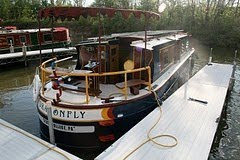
Dragonfly will be cruising the Erie Canal in summer 2019. Check back for regular posts about our adventures starting July 4, 2019. New to the blog? To read about SlowBoat's Great Loop Adventure (a 6,000-mile circumnavigation of eastern North America), start here.

Where Do SolarBoaters Go in the Winter?

If you’re wondering where we went after completing our 2018 “Little Loop” cruise through the historic canals of Canada last summer, the answer is, “Intermission, with Mangroves.”

Can you spot our shiny tiny home, rear right?
We spent November 2018 through April 2019 working as volunteer ranger-naturalists for the U.S. National Park Service in Everglades National Park

Our home base for six months was the smallest of the park’s four ranger stations: Gulf Coast Station, in Everglades City

We lived on site—though not on our boat. For this expedition we acquired  another small, metal-clad residence: an Airstream trailer.

Paddling’s Part of the Job Description!

Gulf Coast station is a portal to the Wilderness Waterway, a 99-mile trackless “trail” for canoeists, kayakers, and fishermen.

Just another day at the office, right?
The Waterway winds among the convoluted coastal mangrove islands stacked up along Florida’s southwest coast. It ends in Flamingo, another remote Park Service outpost at the very tip of the Florida peninsula.

Some friends and family members were bewildered by our decision to spend six months in an area best known for heat, biting insects, alligators, and gigantic snakes--working 32 hours a week for no pay.

But hey! As science nerds who love to paddle, and as newly retired digital nomads who want to do something useful with our free time, we were ecstatic to get picked to be what USPS calls “VIPS” (volunteers in the parks).

This is my other office. Yes, those are
white pelicans in the background.
The job description includes helping rangers lead half-day paddle trips for visitors. (YES! It was our job to paddle. How cool is that?) 

Also part of the job: 1) Serving as naturalist on tour boats looking for dolphins, 2) giving nature talks a couple times a day (Cap’s interactive talk on stone crabs was quite a hit!), and 3) issuing Wilderness Waterway back-country camping permits (this item mostly translates to “Making sure people without much paddling experience don’t get in literally over their heads.”)

We also staffed the visitor center desk, answering everyone's favorite questions ("Where's the bathroom?" and "I'm only here for a day/hour, what should I see?")

Still Recovering from Irma

Gulf Coast Station was hit hard by Hurricane Irma in fall 2017. The visitor center was flooded and ruined. For months, the rangers (and last year’s hardy volunteers) worked out of an open-sided picnic pavilion—no air conditioning, no screens, no running water, no educational displays, none of the usual visitor center resources. 

The temporary Visitor Center. It's December 2018 and the damage from Hurricane Irma in September 2017 is still visible.
The only amenities were a couple of port-a-potties in the majorly potholed parking lot. 

Conditions were a bit less merciless when we arrived. The facilities had been upgraded . . . to a small trailer. (See photo above. The fire department sign said "max occupancy 5 people," which we exceeded just by showing up to work).

Conditions slowly improved. The potholes got fixed, and we moved to a bigger trailer, where we could set up a few nature displays and make coffee.

We Interrupt This Interlude with a Government Shutdown

We learned to hang soffits!
But when the government shut down for six weeks in winter 2019, we were also temporarily out of work. 

(You might think that, as volunteers, we could still hang out and answer visitor questions, clean the bathrooms, pick up litter? You would think wrong).

We’d come down to volunteer. So we picked up some shifts with Habitat for Humanity, an hour north in Immokalee. 

The High Points

People always ask, "What was the high point of the Great Loop Cruise?" The answer is always, “The people we met.” It was the same for our Everglades experience. 

Our colleagues were awesome! The park rangers here hold on to their sense of humor and sense of purpose despite working for an underfunded, understaffed, and sometimes overwhelmed agency where Catch-22 is alive and well.
Gulf Coast Rangers. When life gets tough, the tough go mini-golfing.
It was deeply gratifying when park visitors circled back to let us know that our suggestions for places to visit and things to do resulted in a memorable day. Swearing in little kids as "Junior Rangers" never got old.

And we were humbled by how many visitors thanked us gravely for our service, as if we were military veterans posted to a danger zone rather than polo-shirt-wearing science nerds having the time of our lives. 

We used our days off for day- and overnight paddle trips, for hiking and biking and bird-watching, and (literal high point) for a sightseeing trip in a small plane where we reveled in the vast views of the convoluted coastline we’d been exploring.

As for wildlife: turns out my careful research on "how to survive an alligator attack/ python attack" was unnecessary. 

The gators we encountered were timid slugs. And the region’s estimated 100,000 pythons are very good at hiding. 
Flying high above the coast, it's easy to see why they call this the 10,000 Islands region.


Friday, September 7, 2018

See You Next Summer!

No, our ranger job does NOT involve wrangling Burmese pythons. But if it did, we'd be ready
We completed our tour of Canada's historic canals on Aug. 25, 2018.

Dragonfly, our 14-ton solar canal boat, is "up on the hard" for the winter. The SlowBoat blog will be on hiatus till summer 2019.

From Nov. 1 till the end of April 2019, the Captain and crew of Dragonfly will be living in a different tiny home made of metal. 

Our Airstream trailer will be our home base while we serve as volunteer ranger-naturalists in Everglades National Park.

We'll be at the Everglades City station on the Gulf Coast. Come visit!

To read about the Little Loop Cruise from the beginning, start here.

Monday, September 3, 2018

Solar Truck

Check out that snowy roof!
So we're back in our home port of Macedon.

We've scraped and sanded Dragonfly's rust-pocked roof and it's now a sparkling expanse of white.

We winterized the water tanks. Put away the perishables.

Good Night, Canal Boat


Today she got hauled out of the water, to spend the winter up on stilts, wrapped in plastic till we resume our boat adventures next summer. But that doesn't mean goodbye to solar technology.
Lift her gently there! Don't hurt my baby!

Nuh uh!  At the end of October we head to Florida for a six-month stint as volunteer park rangers at Everglades National Park.  So . . .

Hello, Camper!


Can your truck do THIS?
While we're there,we'll be living in our Airstream trailer. And Cap's been thinking, "How can we make sure we have plenty o' power when boondocking?" ("Boondocking" being trailer speak for, "camping in a place without electrical outlets.")

The answer? Solar truck.


Giving New Meaning to the Term "Ford EcoBoost"


Batteries in the truck bed, and still some room for cargo.
(Alas, we can't help you move your furniture)
OK, full disclosure, our truck does not actually run on solar power. But it IS equipped with a solar panel. 

Normal trucks have a cap or a tonneau cover over the bed. We have nicely sized power-generating solar panel covering OUR truck bed.

And a couple honkin' big storage batteries in a metal box inside the bed. With a solar controller.

All in all, this system is a lot like the one on Dragonfly. Cap's own original design

So now, when we're boondocking, we'll just park in the camper in the shade. Park the truck in the sun. Erect the panel. Run the power cord from the battery bank to the trailer. 

And voila! Laptops and phones charged, fridge nice and cold, and we can leave the light on for ya at night.

Because when we get home from a hard day of rangering (which will involve, among other things, leading canoe trips in the swamp) you know we'll want to open a well-chilled beer and say, "High five! We didn't sink any tourists today!"


Friday, August 31, 2018

Boat Gourmet Cooks Sustainably

You asked for more tips from Boat Gourmet. Sustainability is a theme of our travels, so this installment of Boat Gourmet covers hacks that help you

  • save water;
  • save fuel (i.e., propane for the stove); and
  • reduce waste and pollution

Tip # 1: Scrape before you wash


A rubber scraper is your best friend. Scrape residue into the trash before you do dishes. (Or, train the crew to lick their plates clean.) You'll need less wash water to get them clean.

Plus, you won't pollute the water in your anchorage. Did you know that the sink on a boat drains right into the water? Yup.

No one wants to see your leftover breakfast Cheerios floating away on the current.

Food waste in the water is more than unsightly. Those excess nutrients in an anchorage or marina can cause algal blooms.

Tip # 2 Use Only What You Need


Making coffee? Measure your coffee water into the kettle. (We make four cups of java every morning.)

Think about it. How many mornings have you dumped the stale water from the kettle before starting fresh? That's a waste!

Measuring your coffee water also means you don't use extra propane to boil more water than you need! Which leads me to . . .

Tip # 3  Conserve Fuel


We make sun tea--no boiling water
needed! Small flask fits in small fridge
Beyond the desire to use fossil fuel sparingly, getting your propane tank filled can be a hassle.

You can't always find a place close to the boat dock. And those tanks are heavy to carry!

So plan meals that don't take forever to cook. (The bonus to this strategy--you don't make your boat even hotter on a summer day.)

Beyond the obvious (sandwiches and salads) you have plenty of options.

Thai red curry! On rice, but rice noodles are also delish.


Angel hair pasta cooks in 5 minutes (compared to 11 minutes for heartier pasta substrates).

Even better are couscous and rice noodles. Just boil water, pour over, let sit.

A little protein, some veggies, some seasonings . . . so many possibilities!

Or use a heat source other than your stove. If you're lucky, you're docked in a place where there's a picnic area, with barbecue grills!

In the photo below, Cap shows how he used convenient engine room spare parts to grill in the rain. That's half of a length of some kind of ventilation pipe keeping our nice little steaks dry!


Tuesday, August 28, 2018

What I'm Reading

You know that I like to read books that are set in the place where I'm traveling.
This summer, when we boated Lake Champlain, Cap bought me a book that's given both of us a lot of pleasure: Life on a Canal Boat, The Journals of Theodore D. Bartley, 1861-1889.

Captain Bartley was a diligent and engaging journaler. For 30 years, he ferried cargo on the Richlieu, Lake Champlain, and Champlain Canal (all locations where we traveled this summer).

He also traveled the Erie Canal and Hudson River (as we did on our Great Loop Trip).

And his canal boat, like ours, was a bit unusual. It used a sustainable technology. It was was a sailing canal boat!

A Canal Boat with Sails?

Voila! Sailing canal boat.
Yup! From about the 1840s to to the 1880s, some canal boats carrying cargo between Montreal and New York were built with a mast and centerboard. 

The idea was to sail under your own power on Lake Champlain, then be towed by mules or by a steamboat elsewhere on the route.

 Can We See One? Yes!


Wow! There she is! Hats off to the Lake Champlain Maritime Museum
 for making this rare bit of history come to life!
The Lake Champlain Maritime Museum, which we visited this summer, built and operates a full-scale replica of an 1862 sailing canal boat. (Pictured under sail above left.) 

It was launched in 2004. Since then, the Lois McClure (read all about it, very cool) has been touring around, educating folks on canal boat life. 

Today it was in Palmyra, NY, just a few miles from Macedon. 

So of course we had to go obsess over it--I mean, admire it!

Solar Canal Boat, Sailing Canal Boat: A Comparison


Theodore Bartley's boat was almost identical to the Lois McClure. It's more than twice as long as Dragonfly (88 feet to our 41 feet), half again as wide (14 feet to our 10 feet), and capable of carrying 60 - 120 tons.

Click here to compare to pix of Dragonfly!
Bartley brought his wife and young son along on the boat. The Lois McClure recreates their living space, in the stern of the boat, beneath the steering platform. 

Stairs down, homespun curtains, patchwork quilt, tiny but complete galley, wood panelling . . . it all felt pretty familiar!

A unexpected special bonus treat for us: On the boat was Barbara Bartley, the person who transcribed Theodore Bartley's journals, so that they could be edited into the book. 

(She's his great-granddaughter-in-law.)

Cap chats with Mrs. Bartley belowdecks.
Bartley's canal boat carried lumber, potatoes, grain, coal . . . all the nonperishable staples of the day. His diary documents pleasant days with nice weather, and frightening events: storms, collisions with bridges and other boats, injuries, his son falling overboard. 

He was a multi-talented guy who knew how to sail, was a skilled gunsmith, and, as a carpenter, made the boat more comfortable than was typical of the day for his family.

A typical journal entry reads something like: "Shipped and mended the rudder, repaired some sails, lashed the ends of new lines, made mosquito screens for the cabin, walked to town for supplies, loaded 5000 bushels of grain . . . didn't do much else today." 

Makes us feel like slackers!

Time to Do as Bartley Did

And with that, I'm headed back to the boat. We're taking this week in port to grind off the rust and put on fresh paint.  

So if you come cruising with us next summer (we're thinking Lake Champlain!) Dragonfly will be looking her best.