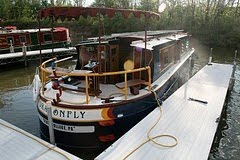
We stayed for two days at the marina in Columbus, Mississippi. The town does have a Saturday farmer's market. But it shuts down for the season at the end of October. So I bought groceries at a conventional store.
Even when I shop at a supermarket, I'm trying, on this trip, to look for "local" products. My theory: Local brands have been transported a shorter distance than national brands, reducing the amount of fossil fuel consumed.
Saturday, November 6, 2010
Friday, November 5, 2010
On the Verge of a Biofuel Breakthrough?
Wednesday we cruised past a dock where Scott Paper has a shipping terminal. On the bank was one huge pile of sawdust and another huge pile of bark mulch. Nearby a crane was stacking tree trunks with as dispatch, ends butted neatly like soda straws in a dispenser.
As we cruised towards Columbus, Mississippi, I checked the local paper to see what I could learn about sustainable energy projects here. Apparently I had just missed a local Rotary Club meeting where the speaker proclaimed that "Mississippi is poised to become a national leader in renewable energy production." And the reason: The state's abundant timber.
Labels:
sustainable technologies
0
comments
Thursday, November 4, 2010
Beautiful Boondoggle
![]() |
| Most daymarks are mounted on land, not rock cairns |
The Tenn Tom doesn't look like much at first glance. Construction was completed in 1984, and 26 years is not a whole lot of time for nature to reclaim bare earth.
So on the initial section, the 27 miles known as the "Divide Cut," it's clear you are traveling a canal. The banks are even and neatly leveled, plastered with rip-rap (small boulders that discourage soil erosion). Industrial-style cement walls border the occasional causeway that admits water from a small tributary creek. Grass, weeds and some small trees have grown on the sloping banks, softening the impression that you're traveling the water equivalent of an interstate highway.
Wednesday, November 3, 2010
What IS It?
Periodically, this blog invites you to ponder some of the odd and unusual things we spot. On Sunday we started a new phase of our voyage when we entered the Tennessee and Tombigbee Waterway, a man-made waterway--not old, like most U.S. canals, but opened in the 1980s--that connects the Tennessee and Tombigbee Rivers. Running due south, the waterway gives commercial and recreational boats an alternative to cruising down the Mississippi River on the way to the Gulf Coast.Anyway, coming around a bend this sunny Sunday, we spotted a field of colorful floats, nearly obstructing the channel. Each one was about the size of a Coke can, and each was brightly colored: blue, pink, yellow, Kelly green, lavender. There was no sign to indicate whether it was safe to pass by.
So What IS It? (Or, What ARE They?)
Monday, November 1, 2010
Are You Feeling Loopy?
"Looper." It
sounds like a kind of pesky forest caterpillar. But that’s the name for boaters who are travelling the route
called "The Great Loop."
We just spent three days at
the “fall rendezvous” of the America’s Great Loop Cruisers’ Association (AGLCA)--an
event held every year at Joe Wheeler State Park in Rogersville, Alabama.
The Cap’n sends this guest blog about
the experience.
![]() |
| The docks and lodge at Joe Wheeler State Park in Alabama |
We joined about 200 other “Loopers”
for lectures, workshops, demonstrations, and social events. Participants
included people like us, who are currently looping (most arrived by boat), plus
Looper “alumni” who have already completed the trip and folks who are planning (or fantasizing) about some day taking
a year to circumnavigate eastern North America. Also on hand were boat brokers,
marina managers, and marine supply dealers.
For Cynthia and me, some of
the most useful sessions dealt with specific reaches of the journey, like the
detailed orientation to the Tenn-Tom Waterway given by Fred Myers, the author of
numerous books and articles about inland waterways. The first mate was mightily
excited to learn that, once our boat reaches the salt waters of the Gulf, our
spider infestation will disappear.
Subscribe to:
Posts (Atom)