WPSU

Saturday, June 16, 2018

Picked Up Some Hitchhikers


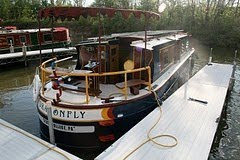
We've cleared the lock in Oswego, headed out of the harbor!
We stayed in Oswego on Friday, June 15. We spent the evening getting ready for the most challenging part of this trip: crossing Lake Ontario.

Eight years ago, when we made the crossing as part of our Great Loop trip, our first day out on the water was rough.  It was cold, and cloudy. 

Dragonfly shimmied like a bucking bronco in the three-foot waves.  We had to tack to keep the rollers from hitting us side on.  At the end of the day I was frozen, seasick, and exhausted.

Will We Make It Across Lake Ontario?


So I was nervous about repeating the crossing. What if we rolled and swamped?  Last night we got out all our safety gear: whistles to tie to our PFDs; waterproof flashlights, signal flag, portable waterproof marine radio all charged up, cell phones in double Ziploc bags.

This morning we got up at 6 AM, to stow anything that could fall off a shelf, or break, or bang around in rough seas. We caught the very first “lock through” at 7 am, going out through Oswego Canal Lock 8, which separates the canal from the lake.

Good-bye Oswego, wish us luck! 
The sun was shining reassuringly. But I was still worried. How would our new systems perform? Would the motor controller overheat, would the batteries hold up to the challenge, would the generator shake itself free of itsmotor mounts? 

We put an extra fire extinguisher on deck. Mapped the marinas along the way in case we needed to bail before our chosen destination, which was Henderson Harbor, about a 22-mile run.

Cross Lake Ontario? No Problemo


A perfect day, and all systems go!
All that worry was needless.  The marine weather forecast had seemed too good to be true: clear skies, warm temperatures, waves less than one foot. But it WAS true. 

We had the most perfect day. The weather was so warm, we were in shirtsleeves. The waters were perfectly calm. The lighthouses were scenic. We spotted a pair of loons.

The SlowBoat Solar Technology Report


We alternated between running on battery power only, and running the generator—which adds charge to the batteries at the same time that the solar panels are filling them up.

And Cap’s new systems performed so well, we decided to keep on cruising’ . . . all the way to Cape St. Vincent, about 55 miles of travel total.  Round of applause for the Dragonfly’s chief engineer, please!

What About Those Hitchhikers?

This good-looking lighthouse welcomes you to Cape
Saint Vincent.
 All in all a perfect day—and more of the same weather expected tomorrow when we make the second leg of the crossing.

There was only one fly in the ointment . . . literally, flies. Hundreds of them.  As we passed Grenadier Island, small, odd looking flies started to settle on our stern solar panels . . .  on our deck flowers, on our windows, and on us. 

Mysterious hitchhikers.  Hundreds of 'em.
They didn’t bite or buzz, they just sat there.  We were miles from shore.  How did they find us, and why were they riding along?  A mystery.

Happily, as we approached our port, the flies flew off.

Friday, June 15, 2018

The Era of Electric Transport

Artistic snowplowing in  Oswego
We're on the Oswego Canal--actually, the Oswego River, with locks to get around the rocky bits. Some stretches are green and wild, others packed with cottages on the shores.

Rising from the  Ashes

We were wind-bound yesterday at Lock 1 in Phoenix, NY, a town whose emblem is the firebird, reborn from the ashes--it's the high school mascot, and even enlivens a snowplow at the town maintenance building.

You might think the name comes from a key event in town history: 100 years ago, a fire destroyed 80 buildings in the downtown district, along the canal.  You would be wrong. Phoenix is named for an early settler, Daniel Phoenix

Traces of Trolleys

One curious thing we've noticed as we've cruised the Erie and Oswego Canals is the many bridges )or abandoned bridge abutments) labeled "trolley bridges." Really? Trolleys in lightly settled, rural upstate New York? I thought you only found trolleys in cities!  I wanted to find out more, so I did some research in the (very nice) Phoenix Public Library on our windy dockside day.

Notice all the places we've been on our cruise: Newark,
Lyons, Clyde, Baldwinsville, Phoenix, Oswego.
Turns out that, as early as the 1850s, there was a horse trolley system in upstate New York. With electrification at the turn of the 20th century, this became an electric trolley system--or as it was called at the time,  the "Auburn and Syracuse Electric Railroad."

This was a private, not public, enterprise, a syndicate headed by one Clifford D Beebe. Just check out this map of the terrain they covered!

The entire route we have just traversed over the past two weeks under electric power could also have been covered thanks to electricity in the early 1900s!  (And much, much faster.)

Electric Transport Ruled--for a While

Remember, this was the era when cars were only just starting to be seen on the roads.  The electric trolley gave mobility to rural residents far beyond horse and buggy transport.

 People in tiny rural towns could hop a convenient trolley to almost anywhere they might wish to go. One man who lived in the rural town of Victor and worked as a clerk in the big city, Rochester told of a 20 minute commute via trolley, faster than  you an drive it today.

Sadly, this and other "Intraurban Electric Railroads" faltered and failed around and after the Great Depression. Why?  Historians aren't clear.  One possibility: Model T's were cheap and available, and individual transport fits with the American ethos of rugged individuality. 

Why didn't the government, or the states, or the municipalities subsidize electric railroads in the way that roads for cars are subsidized? Who knows.

It's fun to fantasize what might have been, if electric transport still ruled in upstate New York.

Where in the World is SlowBoat?

Today we ran from Phoenix 22 miles up to Oswego on the shores of Lake Ontario.  If weather permits we'll "go outside" tomorrow, leaving the placid confines of the canal for the truly big waters of Lake Ontario.


Wednesday, June 13, 2018

Lockin' Through

Follow the yellow brick road . . . 

Helpful links:
  • Use Boat Finder to see what we see. Search on kd3fly-12, then click on "street view"
On June 12 we cruised from Lock 24 in Baldwinsville to Phoenix, NY. That means we have left the Erie Canal and are starting north on the Oswego Canal, toward Lake Ontario.
Masterful Lockage

Approaching the lock: the lock tender opened the lock doors for us.
Over the next three months, we'll pilot through dozens of locks. Happily, our boat is called a "LockMaster."  Yup, Captain Peter Wiles, who built this boat (and a fleet of others) in the 1980s, designed it to be super-easy to take through a lock. 

  • It's straight-sided (not curved) so it nestles flat against the lock wall. 
  • Nifty walkways down each side let the "bow bunny" scamper to the front to grab the line to hold the boat in place
  • This lock is full,  We're going DOWN. My job as bow bunny: grab the line hanging from one of those blue-and-white
    floats.  Then, HANG ON
Compare this image to the one above. Notice the watermark on the walls. The lock tender opened a big drain
at the bottom of the lock. Water flows out, and down we go!


These military-style buildings are typical canal architecture from about 1910 or so. 
Gates are opening.  They make quite a screech. At some locks, herons have learned to fly in at the sound, to look for
fish that may have gotten crunched--easy pickings!

And we're on our way.  Wave to the lock tender and say, "Thanks for the smooth ride!"


Monday, June 11, 2018

Tour du Boat

On the Erie Canal, eastbound toward lock 24
30 miles to go! Will we make it?
We spent Saturday night at the Lock 25 wall, in the middle of Montezuma National Wildlife Refuge. On Sunday we traveled east 31 miles to dock in Baldwinsville, at Lock 24.

Thirty-one miles in a single day on nuthin' but electric power is a new world record for SlowBoat. And we weren't even that slow . . . total run time about 6 hours. Give that Captain a round of applause!

First, The Travel Highlights


A few notes from our trip on Sunday and then (in case you haven't been aboard yet) a quick tour du boat.

Great blue heron on the Erie Canal, visiting our canal boat at Lock 24
Thought bubble over heron's head: "This boat appears to
have a river on its roof. Where are the fish?"
Montezuma is known as great place to bird watch. But we had no idea the birds would be so friendly. As soon as we docked, a great blue heron walked up to say hello.

Next morning we opened the stern doors to see a ruby-throated hummingbird hovering there, as if waiting for us.

Big Water on Cross Lake


One highlight of our cruise yesterday was crossing aptly named Cross Lake. (The lake runs north-south and the canal cuts east-west across its midsection.)

"Big Water": Cross Lake
The first time we made the crossing, 8 years ago, I was terrified--it was the first time we'd been on "big water," or at least anything wider than a canal.  How my view has changed!

Another highlight was cruising past the ruins of the Richmond Aqueduct. It was completed in 1859 as part of a canal expansion and relocation, to carry the canal OVER the Seneca River.

Solar canal boat Dragonfly passing Richmond Aqueduct on the Erie Canal
Those arches supported the bottom of the canal as it passed
over the river.
 Just imagine what it would have been like as a passenger on a canal boat, moving along at that smooth, 4-mph mule-drawn pace, to glance out the window, and see, not forests or fields beyond, as you expected, but a river 40 feet below you!

Come Aboard for a Tour du Boat


And what would it be like to be a passenger on a canal boat today? Come aboard and we'll show you?

Seating space in the bow of solar canal boat Dragonfly (aka SlowBoat)
Let's start from the bow--the front of the boat.  Under that red canvas canopy we have a space that's like a little screened-in front porch.

Two wide seats meet in a vee, with a little table. Nice for reading, or dining al fresco. Lockers under the seats are for storing gear. The screened windows have clear plastic covers (AND canvas covers) that can roll up and attach w velcro to keep out the rain and/or morning sunlight.

kitchen/salon on solar canal boat Dragonfly (AKA SlowBoat)

Boaters Call This "The Salon"


From the bow, it's a small step up into the main cabin--a combination kitchen/dining room/sitting room.

Bill built the dinette at left, elevating it on a platform so that when you are seated, you can still see out the window. (The platform hides two drawers, used to stow canned goods).


Kitchen on solar canal boat dragonfly
The kitchen is miniature but comprehensive: Double stainless steel sinks. Three-burner gas stove. Dorm-sized fridge . Shelves for dishes and glassware.

It would be hard to roast a turkey or make homemade apple strudel here. But pretty much anything else is fair game.

Are You Tired After Reading This? Me Too


Here's our cozy bunk. Because after all that birding, and boating, and baking, sometimes you really need a nap!

Thinking of visiting SlowBoat?  We have a guest cabin too.  You get your own bunk, wash-up sink, and head.

Two heads and two wash-up sinks . . . we hear that these amenities qualify our boat as a yacht.

And here we thought it was a canal boat.
This bunk could be yours!


Saturday, June 9, 2018

What I'm Reading (w BONUS Boat Recipe)


Reading the book SevenEves aboard solar canal boat Dragonfly
When I'm traveling, I like to read books about the place I’m visiting. My current read is NOT set on the Erie Canal. But it’s entertaining to make some connections between this book and our current situation.

The book Is SevenEves, a post-apocalyptic sci-fi doorstop by Neal Stephenson. It’s excellent. (If you haven't read it, I promise no spoilers in this post.)

Put Everyone in a Small Space and See What Happens


The SevenEves plot, super-briefly: Earth is destroyed. Just a few hundred people have escaped to space. Space station . . . boat. Both small, enclosed spaces. 

Heroic on-the-fly engineering ensues as the brave new citizens re-purpose limited materials to address each new challenge. Devise algorithms to avoid being hit by space debris? All in a day’s work. Lasso a comet to use its ice for jet fuel? Roger that!

Bill Carlsen, captain of solar canal boat Dragonfly, works on wiring diagrams
Working on wiring diagrams
Meanwhile, back on OUR small enclosed space, Cap’s been rooting in lockers and sorting through tool chests, drawing up blueprints, wiring and unwiring.  

This new propulsion system is unique. It's his own invention, using some new parts but many scavenged old ones. Every day brings some urgent new engineering challenge. Small canal towns don't have boat supply stores. (Most don't even have auto parts stores!)

Regenerative Braking? If Only!


Center, vertical gray box is motor controller for solar canal boat Dragonfly
See those twin black cables with
yellow at the top? They connect to
 the motor controller
Take a gander at this nice new motor controller (left)  installed while we were becalmed in Lyons. With this device, we'll use our new pair of electric motors more efficiently. But our motor controller is a piece of machinery that was designed (and is marketed) to be used in a car or a motorcycle--you can hook it up to an accelerator pedal, or a twist grip. It doesn’t come with a boat-suitable user interface.

Temporary throttle for solar canal boat Dragonfly
The temporary throttel. Notice the label at right:
BRK. That's the control for regenerative braking.
Not gonna happen on a boat.
So for now, Cap has got it hooked up to this little throttle box (at right, neatly taped to the steering podium). This box is a device you’d use at your workbench, to test your system--it's NOT meant for controlling the speed of a 14-ton boat.  

But it will do for now, till Cap takes it apart and figures out what wires go where, and how to make them interface with our Morris controller (a more normal kind of boat throttle.)

It's a good thing we don’t have to dodge space debris while he’s doing all this. (Considering we're a SlowBoat.)

And unlike the characters in SevenEves, we haven’t yet been reduced to eating the algae grown in the transparent hulls of our “Arklets.”  

Instead, we eat Boat Pizza. (See below. Recipe follows.)

Boat Gourmet! Recipe for quick and easy pizza you can make on your boat
You asked for boat gourmet recipes . . . we provide!
Recipe:

1 cup warm water
1 tsp sugar
1 tsp salt
1 tbsp dry yeast
White flour

Pizza dough is very forgiving, so you don’t have to strictly follow the usual rules for yeasted breads.

Combine the first four ingredients in a good-sized bowl and let sit for a few mins while the yeast foams up.

Add white flour to the yeast mixture, half a cup at a time, mixing with a wire whisk. When the mixture gets too gummy for a whisk, switch to a wooden spoon. Stop adding flour when it pretty much holds together.

Cover the mixing bowl (I used a plate, to avoid wasting plastic wrap) and set it on top of your boat oven which (if you are me) is nice and warm because you are roasting asparagus to go with the pizza.

In 20 mins the asparagus is done and your dough has risen. Punch it down, right there in the bowl and add enough flour so it’s not sticky.  Punch it some more in the bowl (no space on my tiny boat counters to knead the dough on a big board.)

Have ready a cookie sheet sprinkled with cornmeal. Make the dough into a nice round ball, plop it on the sheet, and press it out gently so it fills the entire sheet.

Topping time! I used pizza sauce from a jar, shredded mozzarella, salami, and some red pepper and onion that needed using up.  Your boat fridge may contain other useful pizza toppings.

Sprinkle w oregano, parmesan, and garlic powder. Into that already warm 450-degree oven for 10 mins and dinner is served. Don’t forget the red-wine-in-a-box. (Box wine lighter and easier to store on your boat)

Makes enough pizza for two hungry boaters. Ready in less than an hour.