WPSU

Monday, April 18, 2011

Going Nuclear

Look Ma, no cooling towers!  Calvert Cliffs Nuclear Plant.
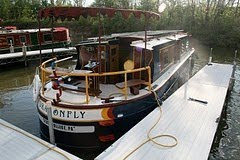
First: We're tied to a dock in Annapolis!  Less than 10 minutes after we landed, a red tour trolley pulled up to point out "the English Canal Boat."

To catch you up on earlier travels: The weather forecast yesterday was grim. "Waves 2 to 5 feet at Chesapeake Beach." But we set out from Solomons anyway, staying close to shore, in the shadow of Calvert Cliffs. And though the wind raged mightily, the water was flat.

The so-called "cliffs" are low, rounded hills that look like layer cakes sliced open.  Inside are fossil-laced strata of gold and brown sand.

We made it to Cheseapeake Beach, where, as the sun set, a full moon boomed up over a glittering sea. Leaving the laundromat at 11 PM, I passed a woman in a business suit and sensible shoes, staring at the glowing disc and the bright water below.  "Drove all the way from Raleigh just to see this," she murmured.

One of the more interesting sights for us on our 25-mile trip yesterday from Solomons to Chesapeake Beach was the Calvert Cliffs Nuclear Power Plant.

About 3 million people live within 50 miles of this plant, including the residents of Washington DC. Built in the mid 1970s, the plant's two generators use the bay as a heat sink for cooling water.

Friday, April 15, 2011

Slimy Signs of Spring

Beware of the blob!
Like Edwin Way Teale, we're headed north with the spring.  Our slow rate of travel means we've enjoyed weeks of bloom: redbud, daffodils, dogwood.

We're in Solomons, Maryland, today and there's another kind of spring bloom here . . . something quite as pretty to look, at but less pleasant to touch: Jellyfish. (Watch 'em swim here).

Ever wonder where the jellyfish have been all winter? When the water gets cold, the adult jellyfish die.  But their offspring have hatched . . . and developed into blobby creatures called polyps. The polyps find something hard on the sea floor, like an oyster shell, and stick tight.

In spring, as the water gets warmer, the polyps bud off free-swimming jellies--the familiar, tea-cup-shaped critters you see in this photo.  And hey, what with the globally warming climate trend, Cheseapeake jellies are showing up nearly a month earlier than they did back in, say, the 1960s.

Thursday, April 14, 2011

Welcome to Dixieland

Both of us want to take this chance to say a heartfelt thanks for your expressions of sympathy over the last two weeks--it means so much to both of us.
In the news: A SlowBoat's-eye view of Fort Sumter, South Carolina,
where the Civil War started 150 years ago this week. 

We've back on the boat today, and heading north up the Chesapeake.   Back in Homer, Mom pointed to the map, raised her eyebrows and said, "You're going to be way out THERE?"

Yup!  Back in the groove: dodging crab pots, waving to the Coast Guard, scoping for loons, which are starting to show their spring checkerboard plumage. Sixty-four degrees and feels like 40, wearing all my fleece.  It's bittersweet. After all, the seed for this trip was planted two years ago when Cap resolved to give his dad a treat by renting a boat and cruising the Erie Canal.

Driving south Tuesday we crossed the line into Virginia and the first thing we saw was an elaborate fireworks establishment, flying the Confederate flag over a billboard that read: "Welcome to Dixieland."
The 33-star flag over Fort Sumter
More info HERE

Dixie!  If you consume any media at all, you may have noticed that Tuesday also marked the 150th anniversary of the start of the Civil War. This trip has floated us past so much Civil War history. Indeed, just a few weeks ago, we visited Fort Sumter, where the first shots were fired on April 12, 1861.

Our trip focuses on energy technologies, not American history or social justice. But these are hardly monolithic topics.  From an economic (and a "principles of physics") perspective, the institution of slavery WAS an energy technology. It was a way to accomplish work.  Slave owners used cheap human labor instead of other energy sources, such as hydropower, wind power, steam power, or horse or mule power.

Cup Overboard!

The saddest sight in the world

We're working our way up the Chesapeake. Hope to be in Annapolis this weekend.

At the first "changing of the watch" this morning, SlowBoat had a moment of drama.

Cap was chasing the morning chill with a steaming cuppa java. He set the cup on one of the stern seats.   And in the shuffling dance to change places . . .  into the drink it went.

Wednesday, April 6, 2011

Can't Start a Fire Without a Spark

We happened to be in a bookstore with a big magazine rack, and this month's issue of Wooden Boat magazine featured, on the cover, a boat with rooftop solar panels and a hybrid diesel-electric propulsion system.

Wait a minute! That sounds like SlowBoat.  But I said "Wooden Boat" magazine.

Yup.  The featured boat is Sparks, and the latest innovation by Ted Moores of Bear Mountain Boats.

Amazingly enough, we got to tour Sparks and meet Ted and his partner Joan Barrett. It was just three months into our year-long SlowBoat cruise.  We landed at the town dock in the hip college town of Peterborough, Ontario, and the dockhand said, "You HAVE to go over to Dock C.  There's a boat just like yours and it's launching today."